

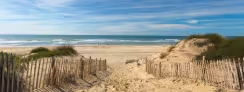





The last stage of La Vélodyssée in the Bay of Bourgneuf-en-Retz (your pedals keeping time with the sweeping circles of its wind turbines!) before arriving at the very lively Port-du-Bec in Epoids. The highlight of the day will be crossing the famous Gois causeway to the Island of Noirmoutier, tides permitting!
Gradients and elevation
Slope breakdown
Road types
- Cycle path
- Routes reserved for cyclists and pedestrians (greenways, cycle tracks, towpaths), separated from cars for maximum safety.
- Shared road
- Quiet minor roads with little traffic (unless otherwise stated in the stage details). Shared with cars (stay alert).
- Not specified
- Data unavailable or being assessed. Please refer to the detailed stage description.
- Provisional
- Section on a road or cycle path awaiting better-quality facilities (see stage details).
Surface
- Smooth
- Asphalt, tarmac or smooth concrete. Optimal comfort.
- Rough
- Fine gravel, compacted stabilised surface or worn tarmac. Less comfortable, vibrations possible.
- Natural
- Dirt, grass, roots or stones. Under 5%: short sections with little impact. Higher percentage: route suited to mountain or gravel bikes only.
- Not specified
- Data unavailable or being assessed. Please refer to the detailed stage description.
Itinerary
From paths to small roads, we reach the Gois. Caution: During the winter, some areas of the Breton marsh are subject to flooding.
⚠️ The cycle path on the Noirmoutier bridge is currently under construction (until June 2025); crossing the bridge requires sharing the lane with other vehicles. For safety reasons, the speed limit for motorized vehicles is 50 km/h to allow for good coexistence between bicycles and vehicles.
Warning! The Gois is a submersible road. Crossing is possible between 1.5 hours before and 1.5 hours after low tide. Crossing the Gois River is not recommended for tourists on bicycles. It can be tricky. Beware of the slippery road and traffic.
A route through the heart of the Marais Breton Vendéen is offered to you to reach La Barre de Monts from Beauvoir-sur-Mer, via quiet roads. This is a temporary route until it's possible to cross the dikes of the Etier de Sallertaine. Follow the yellow signs! A new project, led by the Vendée Department, is currently under study to offer a new route to Vélodysséens. So, be patient! The steps to create new facilities aren't that simple, especially in natural areas.